Season one · Episode 1
The Cask of Marrakesh
Morocco’s first serial killer. Marrakesh, 1906.
This episode describes violence against women and an execution. Listener discretion advised.
Marrakesh, 1906. Thirty-six young women have disappeared from every corner of the city. The trail eventually leads to the shop of a respected, elderly cobbler and letter writer named Hadj Mohammed Mesfewi.
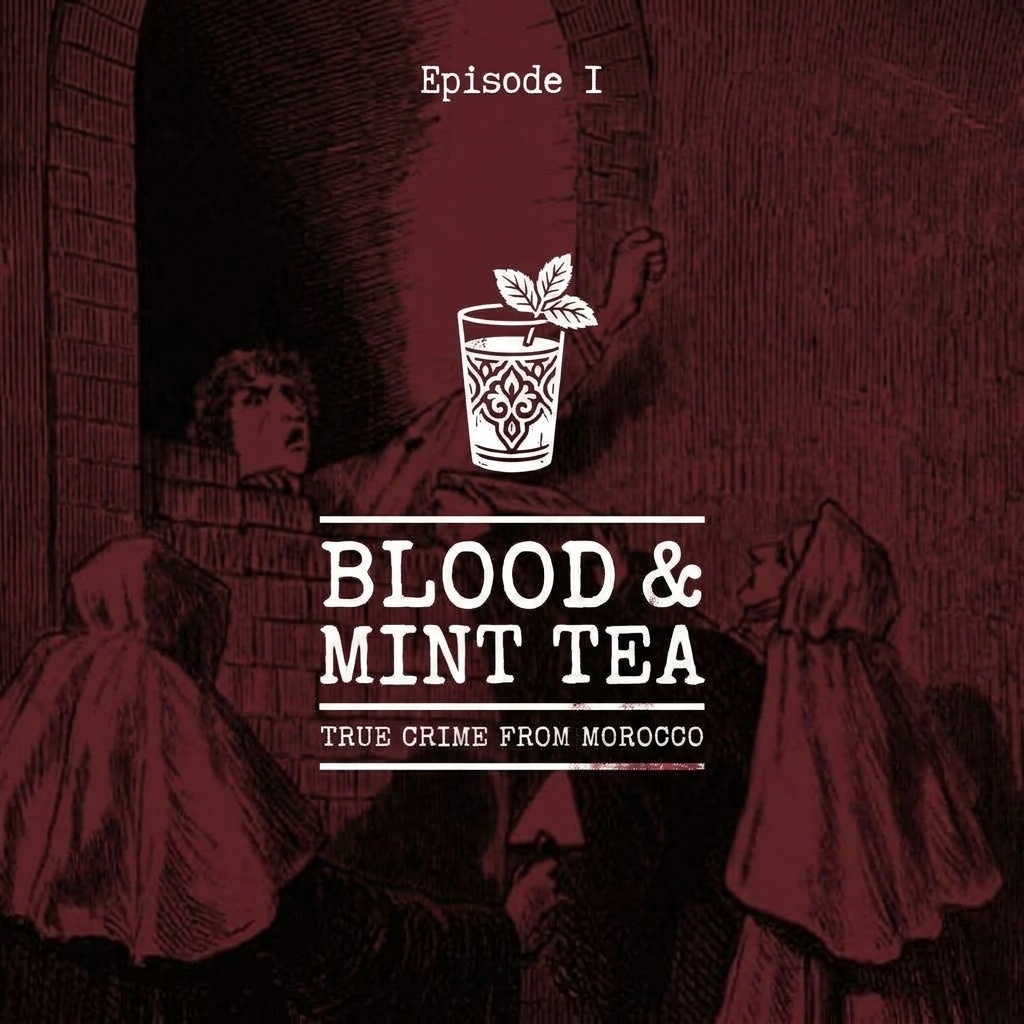
His punishment came out of Morocco’s oldest laws: sealed alive inside a wall in the heart of Marrakesh, in Jemaa el-Fna, before thousands. How did he get away with it for so long? Why did the city choose the wall? Which parts of the story are fact, and which are fiction?
In the series premiere of Blood & Mint Tea: True Crime from Morocco, we follow Morocco’s first documented serial killer throughout our home city of Marrakesh, from his shop to his final resting place, inside the walls of the medina.
Follow Blood & Mint Tea wherever you listen so you never miss a case.
Sources
Everything we used for this episode, in roughly the order it appears. Where a source is in French or Arabic, we’ve noted it.
-
Newspaper · EnglishThe Times and Democrat (Orangeburg, S.C.), 28 June 1906. The Tangier cable, reprinted at length: the core of the record. Library of Congress, Chronicling America.
-
Newspaper · EnglishThe Register (Adelaide), 2 August 1906, p. 4. “Read His Own Obituary.” One of the Australian wire pickups. Trove.
-
Article · FrenchYassine Benargane, “Histoire : Hajj Mohammed Mesfewi, le Jack l’Éventreur de Marrakech emmuré vivant.” Yabiladi, 6 June 2020. Draws on a 2014 article in the Arabic-language weekly Al Ayam. Read it.
-
Article · EnglishLatifa Babas, “Hadj Mohammed Mesfewi, the Morocco serial killer who escaped crucifixion.” Yabiladi, 5 June 2020. Read it.
-
BookSaeida Rouass, The Assembly of the Dead. Impress Books, 2017. Historical afterword.
-
BookSusan Gilson Miller, A History of Modern Morocco. Cambridge University Press, 2013. Background on Sultan Abdelaziz and the Algeciras Conference.
-
BookGavin Maxwell, Lords of the Atlas: The Rise and Fall of the House of Glaoua, 1893–1956. Longmans, 1966. Background on Marrakesh and the Makhzen.
-
Newspaper · EnglishThe Sun (Saint John, N.B.), 8 September 1906. The only period illustration of the case. Wikimedia Commons.
-
Article · FrenchMohammed Fizazi, “Hajj Mohammed Mesfioui, le boucher de Marrakech.” LesEco.ma, 10 September 2019. Read it.
-
Article · FrenchNina Kozlowski, “Hajj Mohammed Mesfioui, le « Jack l’Éventreur » de la médina.” Jeune Afrique, 25 June 2026. Read it.
-
Short storyEdgar Allan Poe, “The Cask of Amontillado.” Godey’s Lady’s Book, November 1846. Full text, Edgar Allan Poe Society of Baltimore.
Transcript
Optional. The corrected Buzzsprout auto-transcript goes here, so the sources stay the visible focus of the page.
Corrections
Anything we got wrong and fixed after release, dated.
Share
Copy link · Instagram · X · Email